My GnuPG key

We can communicate via secure e-mail using GnuPG / OpenPGP, which I strongly recommend. More details in this guide.

For those seeking to write to me, here is my public GnuPG key:

pub
4096R/0xC2B8B57AAAFC29CE 2016-02-29
Fingerprint=EA7F F4E9 08A4 B62D 34E0 9889 C2B8 B57A AAFC 29CE
sub 4096/0x059CDF01110D7CE9 2016-02-29
Se afișează postările cu eticheta Red Hat. Afișați toate postările

miercuri, 21 februarie 2018

Atelier de lucru pentru virtualizare cu OpenShift, organizat de Red Hat și Veracomp România


   Am participat azi la atelierul de lucru dedicat tehnologiei de virtualizare OpenShift, organizat de Red Hat și Veracomp România la hotelul Athénée Palace Hilton din București.
    Instructorul invitat a fost dl. Jaroslaw Stakun, Senior Architect la Red Hat în Polonia.


Workshop OpenShift — Red Hat


Trainer: Jaroslaw Stakun, SA, RedHat


Agenda:
09:30 — Înregistrare și welcome coffee
10.00 — 11.45 OpenShift Container Platform presentation
11.45 — 12.00 Pauza de cafea
12.00 — 13.00 Hands-on labs 1
13.00 — 13.30 Prânz
13.30 — 15.30 Hands-on labs 2


OpenShift furnizează dezvoltatorilor un mediu integrat de dezvoltare (IDE) pentru realizarea și implementarea containerelor formatate în Docker, și pentru gestionarea ulterioară a acestora cu platforma open source de tip container Kubernetes. 

OpenShift este disponibil in 4 modele:
  • OpenShift Container Platform
  • OpenShift Online
  • OpenShift Dedicated
  • OpenShift.io

RED HAT ÎN CIFRE:


luni, 21 octombrie 2013

GNU/ Linux la Politehnică


   La ora când scriu aceste rânduri, tocmai s-a încheiat cea de a șaptea ediție (2013) a evenimentului anual Linux Install Fest, desfășurat la Rectoratul Universității Politehnica București. Mai pe românește, întâlnirea anuală la care proaspeții studenți ai anului I din Facultatea de Automatică și Calculatoare sunt ajutați să se familiarizeze cu sistemul de operare GNU/Linux și să îl instaleze pe laptopurile personale. Ajutorul vine din partea Asociației ROSEdu (http://www.rosedu.org) – adică colegi de-ai lor mai mari și tineri asistenți – iar interesul general este mare, fiindcă GNU/Linux reprezintă subiect de studiu și unealtă de lucru, încă de la primele laboratoare.


Foto: Nicu Buculei


luni, 28 ianuarie 2013

GNU/Linux: libertate sau comoditate?


   Una dintre primele întrebări pe care vi le puneți atunci când începeți să utilizați GNU/Linux este „Ce distribuție să instalez ?”. Paradoxal, de răspunsul la această întrebare vă veți apropia abia după ani de experiență în utilizare și veți înțelege, încet-încet, că nu e unic. Alegerea distribuției potrivite este o artă ce necesită finețe: de multe ori, ea face diferența între un proiect de succes și unul ratat, sau dintre un profesionist destins și un începător speriat. Dacă faceți acum primii pași în GNU/Linux, aceste rânduri își propun să vă vină în ajutor.


sau


joi, 22 noiembrie 2012

Harddisk-uri GPT în GNU/Linux și Windows


Poate că unii administratori de sisteme IT și-au pus deja de problema partiționării noilor harddisk-uri de capacitate mare (2-3 TB), pe noile plăci de bază prevăzute cu UEFI BIOS.

Schema de partiționare recomandată pentru aceste noi harddisk-uri este GPT (prin contrast cu vechea schemă MBR, obligatoriu de folosit pe sistemele vechi, prevăzute cu BIOS clasic).

Detalii despre aceste scheme de partiționare și despre migrarea de la cea veche (MBR) la cea nouă (UEFI BIOS) puteți obține în acest excelent articol, scris de Roderick W. Smith.

Fotografiile de mai jos arată cum se văd partițiile create implicit de către Windows 7 (64 bit) în utilitarele GNU/Linux gdisk (linie de comandă, „moștenitorul” fdisk) și GParted (grafic). Experimentând, am constatat că, implicit, Windows folosește vechea schemă MBR.

Partițiile create IMPLICIT de Windows7 64 bit, văzute în gdisk (schema MBR)


Partițiile create IMPLICIT de Windows7 64 bit, văzute în GParted (schema MBR)

Am creat, cu ajutorul GParted, cea mai simplă configurație de partiții (pentru un sistem GNU/Linux) în noua schemă GPT. Pentru asta, vechea tabelă de partiții (tip ms-dos, în GParted) trebuie ștearsă și înlocuită cu una gpt.


Crearea tabelei de partiții GPT în GParted

 Iată cum arată noile partiții GPT, văzute în gdisk și GParted.


Partiții pentru un sistem GNU/Linux simplu, văzute în gdisk (schema GPT)
Partiții pentru un sistem GNU/Linux simplu, văzute în GParted (schema GPT)

Utilitarele ce au fost folosite sunt din distribuția Fedora 17.

marți, 6 noiembrie 2012

Calculatoare Hewlett-Packard certificate pentru GNU/Linux


Hewlett-Packard (HP), unul dintre producătorii de calculatoare foarte populari în România, oferă laptopuri și stații de lucru certificate pentru lucrul în sistemul de operare liber GNU/Linux.


Pentru sistemele de birou uzuale, distribuția GNU/Linux preferată este Ubuntu (comercializată de firma Canonical).


Pentru servere, sunt folosite Red Hat Enterprise Linux (de la firma Red Hat) și  SuSE Enterprise Linux (de la Novell).


 Pentru utilizatorii care doresc să testeze servere HP fără a încheia și un contract de suport, sunt disponibile distribuțiile GNU/Linux gratuite CentOS și openSUSE.


Recent, Fundația Linux a anunțat că Hewlett-Packard a devenit Platinium Member.

luni, 1 octombrie 2012

De unde vă procurați Linux ?


„De unde-mi procur un CD cu Linux ?” Pentru cei obișnuiți cu lucrul în Tehnologia Informației, întrebarea poate părea retorică sau mult prea banală. Dar câteva experiențe m-au convins că, pentru persoanele netehnice, procurarea primului CD de instalare reprezintă o piedică importantă. Iată, în continuare, câteva idei care sper să vă fie de folos.

  
Citiți articolul complet pe site-ul revistei ITTrends >>


joi, 14 iunie 2012

Cu laptopul la Castel


Cititorilor mei români – mai ales începătorilor – le recomand, fără înconjur, să ia în considerare participarea la „Informatica la Castel”, excelentul eveniment anual dedicat GNU/Linux şi Software-ului Liber  în România. Anul acesta, întâlnirea va avea loc în perioada 27 august – 1 septembrie, iar invitaţia vă este adresată cu plăcere, în limita locurilor disponibile şi cu rugămintea de a vă înscrie din timp.


duminică, 13 mai 2012

An Invitation to “Informatica la Castel”, 2012 Edition - a Romanian Free Software Summer School


I am pleased to announce that, in 2012, the Romanian annual event of “Informatica la Castel” (“Informatics at the Castle”) will be held in August 27th - September 1st. Both international and Romanian speakers and guests are kindly invited to submit their registration for participation.


Already a tradition in the Romanian IT landscape, the event is organized and kindly hosted by the Universitatea de Vest “Vasile Goldiș” (The “Vasile Goldiș” West University) of Arad and ArLUG, the local Linux User Group.

For the summer school, the main focus is to bring together the various Romanian and international GNU/Linux communities (computer geeks and programmers), as well as wannabe GNU/Linux users, newcomers, students, teachers, public clerks, Romanian officials, lawyers, doctors, etc. Every person that uses a computer in day-to-day life (for professional or personal matters) is invited to consider the benefits of Free Software, to improve his/hers computer skills, to learn from more experienced users and to make new friends, by meeting interesting and enthusiastic people in a friendly environment. Last but not least, teachers are encouraged to use more Free Software in class, especially as Virtual Learning Environments – such as http://edu.moodle.ro Moodle platform, kindly offered to the Romanian schools (and supported locally) by Moodle Romania.

One of the keys of success for the school is the natural landscape of the place where the proceedings are held. Very close from the Hungarian border, the 18th century Cernovici Castle of Macea, as well as the surrounding „Pavel Covaci” Botanical Garden offer a relaxing, student camp-like environment, with Transylvanian local traditions, very pleasant for fine academic talks, long walks and making new friends.


You may see other informations, including a few pictures from the 2011 edition, here.

We are anxious to meet you, both Linux beginners or computer gurus !

Event information and schedule

Time: August 27th - September 1st, 2012
(GPS position N 46.38448 / E 21.31015)
Contact e-mail: informatica [AT] uvvg [DOT] ro
Registration: REQUIRED, please register ASAP. Please create yourself a free account on the website and contact organizers via e-mail (attn. Prof. Antoanela Naaji or Prof. Mihai Jalobeanu).
Costs of participation: accessible to students :) . Please contact organizers for details.


sâmbătă, 1 octombrie 2011

Despre Software Liber, ÎN ROMÂNIA


Experienţe recente, din zona „pedagogică”, m-au făcut să reflectez la avantajele pe care Software-ul Liber le poate aduce învăţământului din România şi Administraţiei Publice româneşti şi la relativa uşurinţă cu care ele ar putea fi obţinute. Pentru că şcoala tocmai a reînceput, iar interesul participanţilor la evenimente şi numărul de întrebări primite s-au dovedit a fi mari, iată aici câteva concluzii concrete.


Citiți articolul complet pe site-ul revistei ITTrends >>


duminică, 4 septembrie 2011

"Informatica la Castel" Free Software Summer School, 2011 edition, Romania


GNU/Linux, Moodle, Fedora, Ubuntu, LibreOffice... Freedom... (a picture by Cătălin Donici)

Free Software at The Castle (a picture by Cătălin Donici)


At the end of August, I was pleased to participate at "Informatica la Castel" ("Informatics at the Castle") Free Software Summer School, 2011 edition.

This annual event - already a tradition among Romanian computer geeks - is kindly hosted by Universitatea de Vest "Vasile Goldiș" ("Vasile Goldiș" West University) and ARLUG, the Arad Linux User Group. It's like a pleasant summer camp, at the 1724 Cernovici Castle (position), in the beautiful landscape of Macea village - about 20 km away from the city of Arad, Romania and near the Hungarian border.

Each year, the event's goals are not only purely tech talks, but also raising awareness of Free Software ("Software Liber") benefits for the large, non-technical Romanian public. We also debated on the practical aspects - including financial implications - of Free Software implementations in Romanian Public administration - a zone where there is still a lot of work to do.

The 2011 edition was also focused on e-learning: the e-learning (free) software Moodle and its practical applications in Romanian-speaking education network. The subject stirred up much interest and participation, not only from Romania (schools, high-schools, universities), but also from Moldavian universities of Chișinău, Bălți and Tiraspol. This year, the summer school enjoyed the direct help and participation of the Moodle Romania team, which has a strong presence in Arad county.

Demonstrating GNU/Linux installation and basic operations to present Microsoft Windows users was another task for the school - each year, Linux installfests are permanent agenda. The organisers seek participation from the largest possible number of wannabe GNU/Linux users and newbies (students, pupils, public clerks, teachers of all grades). Not only a small "computer laboratory" was available (running a wide selection of GNU/Linux distros, such as Fedora, Debian, CentOS, Xubuntu, Trisquel, Ubuntu, and Fedora LXDE), but we have demonstrated the install of GNU/Linux for both desktops and servers (Ubuntu 11.04, CentOS 6.0 and a Moodle server on Ubuntu).

(Due to recent history and political regime, Romania's start in wide use of computer technology is a post-1990 matter. Thus, the Romanian computer market has a few particularities that distinguishes it from the Western countries. For one, the Romanian technological landscape is centered on desktop - large datacenters, together with their Unix-like, '70s cyberculture are virtually absent, even in universities. As a desktop Linux distro, Canonical's Ubuntu Desktop has a clear place here, together with Red Hat's Fedora. Second, the low-to-average IT educated user is deeply entrenched in proprietary programs - that's because a whole generation of IBM-PC users gained their first IT skills in Microsoft software, in a Microsoft-dominated public schools system. Third, the harsh economic conditions still encourage the illegal copying of proprietary computer software, eliminating the "price advantage" of Free Software and discouraging the use of these technically superior solutions.)

Last but not least, the Free Software Summer School brings a lot of fun for participants - some of which are "veterans". It's an invaluable occasion to make friends, share ideas and have long, passionate face-to-face discussions on technical, social and "political" matters. As for relaxation and "peace of mind" after tech talks, this year we had a short trip to Bezdin and Hodoș-Bodrog nearby monasteries - wonderful pieces of Christian faith engraved in stone - some foot walks along Mureș river and, of course, a camp fire, evening dance, fine dishes and local wine.

The Cernovici Castle is not only the center of Macea village, but also a landmark for botanists. Its 0.1 square miles park is a botanical and arboretum scientific garden, well-known over the world. There are more than 3000 species of plants and trees here, some of them rare for the Romanian geographical latitude. At night, this is a park with dark alleys, where scaring ghosts appear frequently - please see some of the following pictures  :-) 

There were many presentations available, on various subjects - from the use of Moodle in Romanian and Moldavian universities curricula to computer games and HTML 5 & JavaScript programming. This year, I tried to explain to the Romanian audience the goals of the FreedomBox Project , together with some other considerations on computer security, online privacy and the capital importance of Net Neutrality.

In no particular order, here are some pictures - that worth more than a thousand words (not only mine, but courtesy of Prof. Mihai Jalobeanu, Prof. Pavel Moș, Prof. Daniel Popa, Mr. Liviu Berecz and Mr. Bogdan Lăzărescu).

On my way to Macea, early first day
One of Macea's churches
The Cernovici Castle, somewhere in Europe
Traces of history...
Stairway to heaven...
The night falls...
In Arad
Ready for work - first day (front: Prof. Paula Spânu, Prof. Florența Mereuță)
Prof. Aurel Ardelean, University's Rector, surrounded by journalists
Tech talks (front: Prof. Valeriu Cabac, Mr. Ioan Fericel from ARLUG)
Mr. Cosmin Herman demonstrates how Moodle server runs on Ubuntu
Focused attention... (a nice smile from Anca Mustea)  :)
Along Mureș river
Bell tower at Hodoș-Bodrog Monastery
Completely surrounded... :)  (with Igor Postolaki, Paula Spânu, Florența Mereuță)
"Up to you, My Lord..." (Hodoș-Bodrog Monastery)
"Venite, adoremus..."
Detail from Hodoș-Bodrog's Monastery entrance
How we use Moodle in State University of Moldova
Me, installing CentOS 6.0
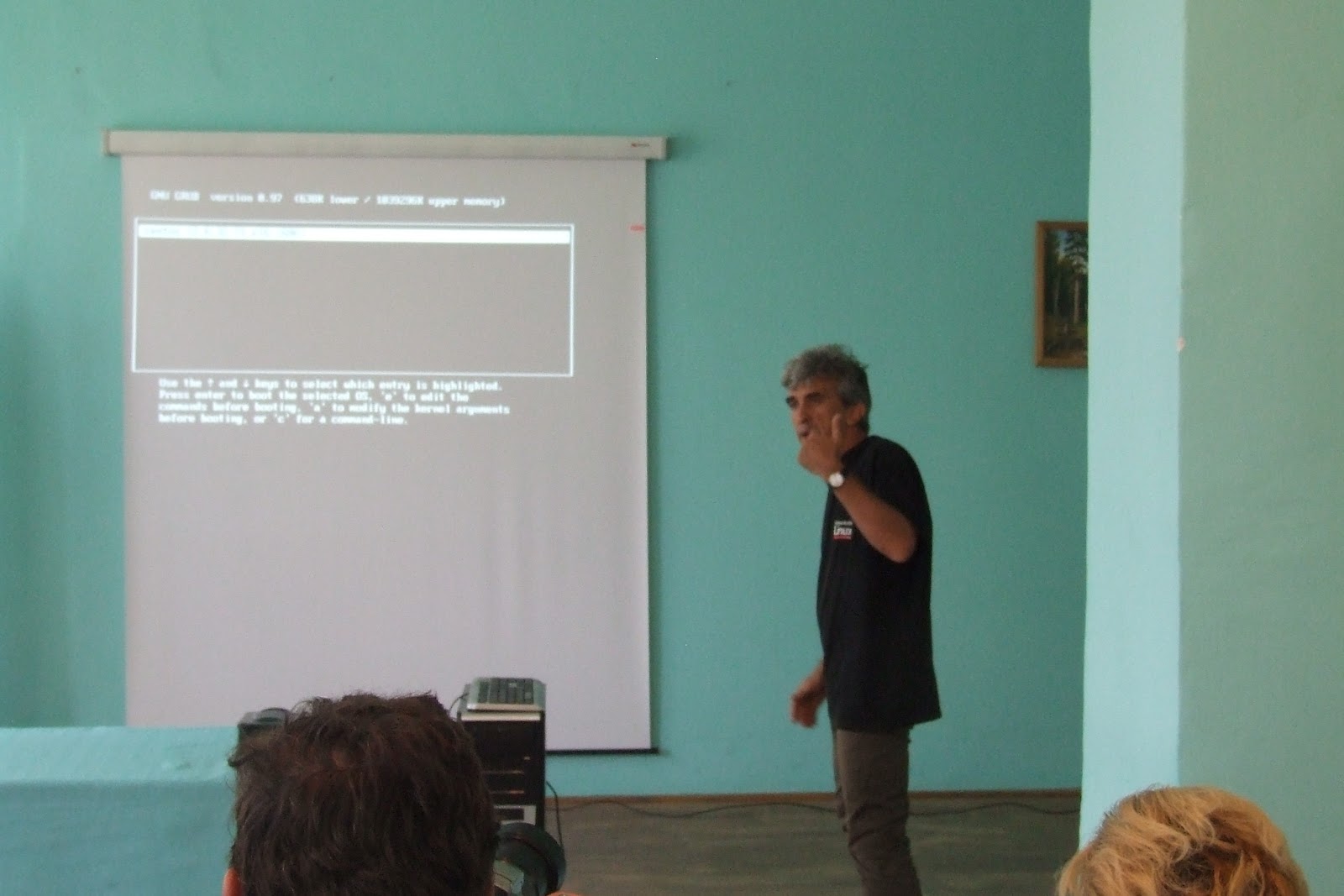
The first GNU/Linux kernel boots...
... and some explanations
From the Macea museum: an old telephone switchboard
Tasting Romanian grill ("mici") and Moldavian cognac...
Camp fire (with Florența Mereuță)
With Prof. Mihai Jalobeanu (center) and Doru Ilași
Free Software comes to Romania!
Historical Romanian locomotive ("131.000") displayed in Arad railway station
The Moodle Romania team explains technical details
"Liberate your documents! Use OpenDocument format!"
Proceedings in the main hall (front: Iuliu Oană)
I'm speaking, audience sleeps...  :)
Old trees in Macea arboretum garden
Pavel Covaci, the botanical garden's director
"Following thoughts..."
Night falls over the century-old trees...
Prof. Roza Dumbrăveanu talks about the Moldavian State University
The Castle... sunny day... friends around...
Sharing some ideas on FreedomBox and LIBERTY
FreedomBox software is based on Debian
A few "bibliographic" references: Sir Tim Berners-Lee, Evgeny Morozov, Mr. Eben Moglen...

The Bezdin Monastery (Serb)
The Bezdin wall pictures
Tons of flowers at Hodoș-Bodrog
The painted church of Hodoș-Bodrog
CentOS 6.0 installer runs smoothly
OpenOffice.org, LibreOffice... (here, OpenOffice.org on CentOS 6.0)
During talks (at left, Prof. Daniel Popa)
The Macea market: "boia" is a traditional Hungarian spice
Staircases in the castle, with historic wrought iron
Prof. Sabin Buraga (Univ. of Iași) presents HTML5. Dragoș Acostăchioaie seeks freedom, running :)
Holy icon in the Monastery of Bezdin
Hunt trophies in Macea's museum
Walking in the botanical garden (with Prof. Antoanela Naaji, Prof. Mihai Jalobeanu, etc.)
Seeking for rare plants

Ghosts show up in the castle's park. Can it be Daniel Popa? :)
Dracula's castle, by night ?  :)


Group of furious ghosts attacks from behind the trees, lead by Sabin Buraga, Victor Porof and Liviu Berecz :)